Now booking discovery conversations for Q3 2026, find a time that works for you
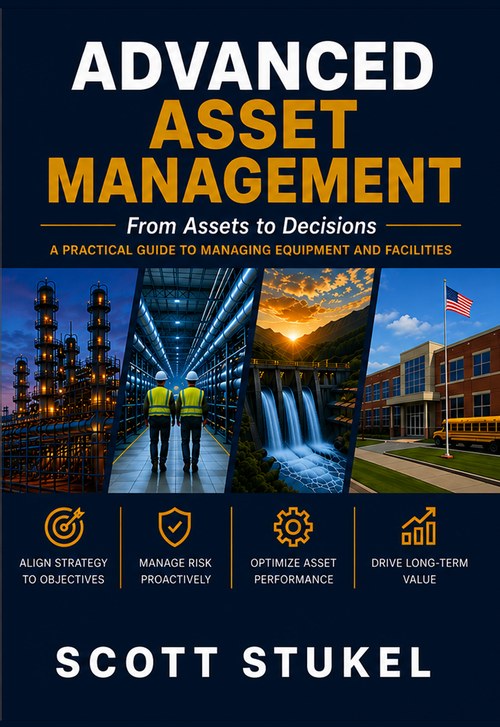
Advanced Asset Management book cover
The book by Scott Stukel

Advanced Asset Management

From Assets to Decisions
A Practical Guide to Managing Equipment and Facilities

By Scott Stukel · Founder, Whites Elm Consulting · 37+ years in the field

Align Strategy
to Objectives
Manage Risk
Proactively
Optimize Asset
Performance
Drive Long-term
Value
What the book is about

From asset data to strategic decisions.

Organizations rely on assets every day — but too often lack the information and processes needed to make confident, informed decisions.

Advanced Asset Management provides a practical roadmap for turning asset information into decisions that balance cost, risk, performance, and service delivery.

This comprehensive guide connects asset inventories, condition assessments, risk analysis, maintenance strategies, lifecycle planning, governance, and capital investment planning into a single, integrated decision-making process.

If you’re responsible for the assets your organization depends on — and the decisions others will judge you by — this book is written for you.
Inside you’ll learn

The full asset-management decision chain, end to end.

Each chapter builds on the last. Read it front-to-back for the complete framework, or dip in when a specific decision lands on your desk.

Read a few excerpts

A sample of the voice, and the argument.

Three short passages from three different chapters. Plain-spoken. Practitioner-first. The tone of the whole book.

From Chapter 2 · From Maintenance to a Business Discipline
Reactive operation does not announce itself; it accumulates quietly, year over year, until a single failure surfaces a decade of accepted risk all at once. The failure itself is rarely the problem. It is merely the moment when years of deferred decisions become visible.
From Chapter 8 · Operations, Sustainment, and Reliability
Industry references consistently estimate that operations and maintenance account for 60–80% of an asset’s total cost of ownership over its service life — which means that the strategies governing sustainment have more cumulative financial leverage than nearly any other asset management decision.
From Chapter 9 · EAM/CMMS Systems: From Record-Keeping to Decision Support
Systems do not create an asset management approach; they reflect it. A disciplined organization with a basic CMMS outperforms an undisciplined organization with a sophisticated EAM, every time. The system can scale a discipline that exists; it cannot manufacture one that doesn’t.
Table of contents

Seven parts + a full appendix set. 21 chapters. The complete decision chain.

Click any part to expand; click any chapter to see its sub-sections. Read straight through, or dip in.

PART IOrientation And First Principles4 chapters
Meet Riverside Water Utility — Our Recurring Case Study
Chapter 1 — What Is Advanced Asset Management, Really?8 sections
  • What Is Asset Management?
  • What Is Advanced Asset Management?
  • How Advanced Asset Management Differs from Traditional Approaches
  • What Advanced Asset Management Is Not
  • How the Elements Work Together
  • Setting the Stage
  • Sector Context, Advanced Topics, and Common Questions
  • Chapter 1 Summary and Key Takeaways
Chapter 2 — From Maintenance to a Business Discipline7 sections
  • Why It Matters, and Why Now
  • The Shift from Maintenance to a Business Discipline
  • A Common Language for Stakeholders
  • Defensible Funding and Resource Allocation
  • Long-Term Visibility and Sustainability
  • Sector Context, Advanced Topics, and Common Questions
  • Chapter 2 Summary and Key Takeaways
Chapter 3 — The Evolution of Asset Management Standards and Best Practices7 sections
  • How Asset Management Evolved
  • The Standards That Codified the Discipline
  • Standards as a Compass, Not a Map
  • Best Practices Grounded in Standards and Experience
  • Sector Context, Advanced Topics, and Common Questions
  • Practical Implementation Notes
  • Chapter 3 Summary and Key Takeaways
Part I Parting Thoughts: The Foundation of the Discipline
PART IIMaturity, Governance, And Intentional Progress3 chapters
Chapter 4 — Maturity, Progress, and Organizational Reality10 sections
  • What Maturity Actually Means
  • The Philosophy of Deliberate and Reasonable Maturity Progression
  • The Five Maturity Tiers
  • Inside Tiers 4 and 5: What Proactive and Cognitive Practice Actually Look Like
  • Industry Benchmarks: What Stability at Each Tier Looks Like
  • Organizational Constraints That Bound the Pace
  • Future vs. Legacy Asset Management Mindsets
  • Why Deliberate Progression Works
  • What Goes Wrong, and How to Recover
  • Chapter 4 Summary and Key Takeaways
Chapter 5 — From Initiative to Institution: Governance, Leadership, and Trust13 sections
  • Why Some Programs Endure and Others Fade
  • What Makes Asset Management Sustainable
  • Governance, Leadership, and Trust as Operating Conditions
  • Intentionality as the Defining Trait
  • The Vision for the Future of Advanced Asset Management
  • Workforce and Knowledge-Loss Risk: The Silent Driver
  • What This Means for Leaders
  • Governance Benchmarks: What Sustaining Programs Look Like
  • Sustaining Asset Management Over Time
  • Why Asset Management Programs Lose Momentum
  • Embedding Advanced Asset Management in Organizational DNA
  • What Goes Wrong, and How to Recover
  • Chapter 5 Summary and Key Takeaways
Part II Parting Thoughts: Intentional Progress Over Perfection
PART IIIThe Enterprise Roadmap5 chapters
Chapter 6 — Establishing the Asset Management Roadmap10 sections
  • What the Roadmap Is For
  • Strategy and Leadership Foundations
  • Goals, Strategy, Objectives, and Tactics
  • Common Pitfalls in Goals, Strategy, Objectives, and Tactics
  • Establishing Risk Tolerance and Trade-Off Philosophy
  • Roadmap and Governance Benchmarks
  • Organizational Alignment and Structure
  • What Goes Wrong, and How to Recover
  • Sector Context, Advanced Topics, and Common Questions
  • Chapter 6 Summary and Key Takeaways
Chapter 7 — Lifecycle Thinking and Long-Term Stewardship8 sections
  • What Lifecycle Thinking Actually Buys You
  • From Assets to Long-Term Stewardship
  • Lifecycle Continuity Through the Roadmap
  • Early Decisions and Long-Term Consequences
  • Lifecycle Benchmarks
  • What Goes Wrong, and How to Recover
  • Sector Context, Advanced Topics, and Common Questions
  • Chapter 7 Summary and Key Takeaways
Chapter 8 — Operations, Sustainment, and Reliability (RAM)7 sections
  • Sustainment: The Largest Single Lever
  • Sustainment Strategies
  • Common Pitfalls in Sustainment Strategies
  • Sustainment Strategies as a Strategic Lever
  • What Goes Wrong, and How to Recover
  • Sector Context, Advanced Topics, and Common Questions
  • Chapter 8 Summary and Key Takeaways
Chapter 9 — EAM/CMMS Systems: From Record-Keeping to Decision Support13 sections
  • Start With the System Question, Not the Tool Question
  • The Enterprise Asset Management (EAM) / CMMS System
  • EAM/CMMS Systems: Uses, Benefits, and Pitfalls
  • Common Pitfalls in EAM/CMMS Use
  • The System as Hub Among Many
  • The Maturity Arc of System Use
  • The Evolution from Systems of Record to Cognitive Asset Intelligence
  • EAM/CMMS Benchmarks
  • The True Value of the System
  • What Goes Wrong, and How to Recover
  • Methodology Deep-Dive: System Implementation Patterns
  • Methodology Deep-Dive: Data Governance for EAM/CMMS
  • Chapter 9 Summary and Key Takeaways
Part III Parting Thoughts: Building the “Operating System”
PART IVKnowing What You Own5 chapters
Chapter 10 — What Assets Do We Have? Asset Identification8 sections
  • Why Identification Matters
  • Asset Identification: Foundations
  • Determining Whether Something Is an Asset: The Five-Lens Framework
  • Asset Identification Benchmarks
  • What Goes Wrong, and How to Recover
  • Sector Context, Advanced Topics, and Common Questions
  • Practical Implementation Notes
  • Chapter 10 Summary and Key Takeaways
Chapter 11 — Asset Registers, Templates, and Data Sufficiency10 sections
  • What a Working Register Earns You
  • Asset Register Principles
  • Asset Register Benchmarks
  • Asset Templates
  • Data Sufficiency vs. Perfection
  • Scalability and Governance
  • What Goes Wrong, and How to Recover
  • Implementing the Register: A Practical Roadmap
  • Sector Context, Advanced Topics, and Common Questions
  • Chapter 11 Summary and Key Takeaways
Chapter 12 — Asset Organization and Hierarchies12 sections
  • What Hierarchy Buys You
  • Asset Organization
  • Vertical Hierarchies
  • Horizontal Perspectives
  • Alignment with Responsibility
  • Standardization Across the Enterprise
  • Asset Organization Benchmarks
  • Avoiding Over-Complexity
  • What Goes Wrong, and How to Recover
  • Sector Context, Advanced Topics, and Common Questions
  • Practical Implementation Notes
  • Chapter 12 Summary and Key Takeaways
Chapter 13 — Asset Strategy and Asset Plans8 sections
  • What Strategy Does That a List Doesn’t
  • Asset Strategy and Asset Plans
  • Right-Sizing Strategy by Criticality
  • Simpler Beats Sophisticated
  • Strategy as the Bridge Between Data and Decision
  • Strategy and Plan Benchmarks
  • Sector Context, Advanced Topics, and Common Questions
  • Chapter 13 Summary and Key Takeaways
Part IV Parting Thoughts: Knowing What You Own
PART VCondition, Risk, And Decision Intelligence5 chapters
Chapter 14 — What Shape Are Our Assets In? Asset Condition and Health9 sections
  • What Condition Tells You, and What It Doesn’t
  • The Purpose of Asset Condition and Risk
  • Methods for Assessing Condition
  • Condition Assessment Benchmarks
  • Making Condition Assessment Practical
  • What Goes Wrong, and How to Recover
  • Sector Context, Advanced Topics, and Common Questions
  • Practical Implementation Notes
  • Chapter 14 Summary and Key Takeaways
Chapter 15 — From Condition to Failure9 sections
  • From Condition to Failure: The Translation Step That Drives Decisions
  • Condition Rating Scales and Consistency
  • Failure Mechanisms
  • Failure Analysis Benchmarks
  • From Observation to Likelihood
  • What Goes Wrong, and How to Recover
  • Sector Context, Advanced Topics, and Common Questions
  • Practical Implementation Notes
  • Chapter 15 Summary and Key Takeaways
Chapter 16 — Asset Criticality and Consequence8 sections
  • Criticality: The Consequence Side of Risk
  • Asset Criticality
  • Common Pitfalls in Criticality Assessment
  • Criticality Benchmarks
  • Criticality as a Communication Tool
  • Asset Criticality as the Foundation of Risk
  • Sector Context, Advanced Topics, and Common Questions
  • Chapter 16 Summary and Key Takeaways
Chapter 17 — Asset Risk: Integrating Likelihood and Consequence4 sections
  • Risk: The Integrator of Likelihood and Consequence
  • Risk Management Benchmarks
  • Common Pitfalls in Asset Risk Management
  • Chapter 17 Summary and Key Takeaways
Part V Parting Thoughts: Condition, Risk, and Decision Intelligence
PART VIFrom Insight To Action4 chapters
Chapter 18 — What Do Our Assets Need? From Insight to Asset Needs8 sections
  • From Knowing to Doing: The Translation Step
  • From Deficiency to Need: The Upstream Artifact
  • From Asset Insight to Asset Needs
  • Common Pitfalls in Translating Asset Insight to Asset Needs
  • Asset Needs Benchmarks
  • Sector Context, Advanced Topics, and Common Questions
  • Practical Implementation Notes
  • Chapter 18 Summary and Key Takeaways
Chapter 19 — Backlog, Deferral, and Time-Phased Planning9 sections
  • Backlog and Deferral: The Real Operating Picture
  • Backlog and Backlog Management
  • 1-, 2-, and 5-Year Work Plans
  • Time-Phased Planning Benchmarks
  • Deferred Maintenance: A Discipline Within Backlog
  • What Goes Wrong with Managing Backlog, and How to Recover
  • Sector Context, Advanced Topics, and Common Questions
  • Practical Implementation Notes
  • Chapter 19 Summary and Key Takeaways
Chapter 20 — Investment, Funding, and Execution5 sections
  • Closing the Loop: From Plan to Outcome and Back
  • Investment Strategy vs Funding Strategy
  • Execution and Continuous Improvement
  • Sector Context, Advanced Topics, and Common Questions
  • Chapter 20 Summary and Key Takeaways
PART VI — Parting Thoughts: From Insight to Action
PART VIIPutting It Into Practice2 chapters
Chapter 21 — Putting It All Together: Riverside Water — A Decade of Advanced Asset Management10 sections
  • Riverside at a Glance – Years 0 to
  • Phase 1 (Years 1-2): The Catalyst and the Honest Assessment
  • Phase 2 (Years 3-4): Building the Discipline
  • Phase 3 (Years 5-6): Visible Outcomes and the Funding Conversation
  • Phase 4 (Years 7-8): Stewardship and the Long View
  • Phase 5 (Years 9-10): The Compounding and the Question of What’s Next
  • What Riverside’s Decade Illustrates
  • The Real Lesson of Riverside's Decade
  • Practical Implementation Notes
  • Chapter 21 Summary and Key Takeaways
PART VII — Parting Thoughts: From Decisions to Outcomes
APPENDICESReference Material17 items
Afterword — From Reading to Practice
APPENDIX A — Mapping Pitfalls to Corrective Actions
APPENDIX B — Sample Common Advanced Asset Management Goals and Strategies
APPENDIX C — Sample Asset Register Template
APPENDIX D — Sample Criticality Scoring Sheet
APPENDIX E — Sample Risk Acceptance Form
APPENDIX F — Sample Deferred-Risk Register Template
APPENDIX G — Consolidated Industry Benchmark Reference
APPENDIX H — Sample Asset Management Policy
APPENDIX I — Sample Asset Management Plan (AMP) Outline
APPENDIX J — Maturity Self-Assessment Checklist
APPENDIX K — Sample Capital Project Justification Template
APPENDIX L — Standards and Frameworks Reference
APPENDIX M — Crosswalk of Deferred Maintenance & Backlog Terminology
APPENDIX N — Common Acronyms
Glossary
Bibliography and Further Reading
Order the book

Available in three formats.

Published by Whites Elm. Pick your format — all three land on Amazon.

Kindle eBook

$19.99
Portable reference. Highlight, search, and read on any device.
Buy on Kindle
Most popular

Paperback

$44.95
Working reference for the office desk. Marks up well; travels well.
Buy paperback

Hardcover

$69.95
Library-quality edition. Ideal as a gift or for the team’s reference shelf.
Buy hardcover

ISBN 979-8-19976-192-5 · Published by Whites Elm

About the author

37+ years in the field, distilled into 400 pages.

Scott Stukel

Scott Stukel

Scott is an asset management consultant, speaker, author, and founder of Whites Elm Consulting. For more than three decades, he has helped organizations across education, utilities, manufacturing, government, and infrastructure sectors improve asset performance, reduce risk, and make informed investment decisions.

His experience spans asset management strategy, facilities management, enterprise asset management systems, capital planning, maintenance optimization, and organizational transformation — the same ground the book walks the reader through.

More about Scott & the team Book a 30-min conversation
Beyond the book

The book is the framework. We’re the team that runs it with you.

Reading it will sharpen how you think about asset decisions. Working with Whites Elm turns those ideas into a program your team actually runs after we’re gone.

Book a 30-min review Explore our services
Advanced Asset Management